Good staff planning in a bowling centre starts with the bookings. If you know how many lanes are booked at what time and how many guests are coming with food, you also know how many staff you need at the counter, in the kitchen and on the lanes. Your booking data shows you both: the patterns of the past and the bookings for the coming days.
Why gut feeling is not enough for the rota
In many bowling centres, the rota is based on experience: Friday and Saturday evenings are fully staffed, and during the week a small team is enough. That is often true, but not always. A company event on a Tuesday, a school class in the morning or a quiet Saturday in summer do not fit this pattern.
You probably know the consequences:
- Too few staff. Guests wait at the counter, the kitchen cannot keep up, and your team is exhausted by the end of the shift.
- Too many staff. Employees stand around on a quiet evening, and staff costs do not match revenue.
- Last-minute stopgaps. Whoever is needed to step in for a large group gets a call on the same day.
Booking data turns gut feeling into a plan you can justify and check.
Which booking data matters for staff planning in a bowling centre
Not every figure in the booking system matters for the rota. These four help most.
Lanes booked per hour
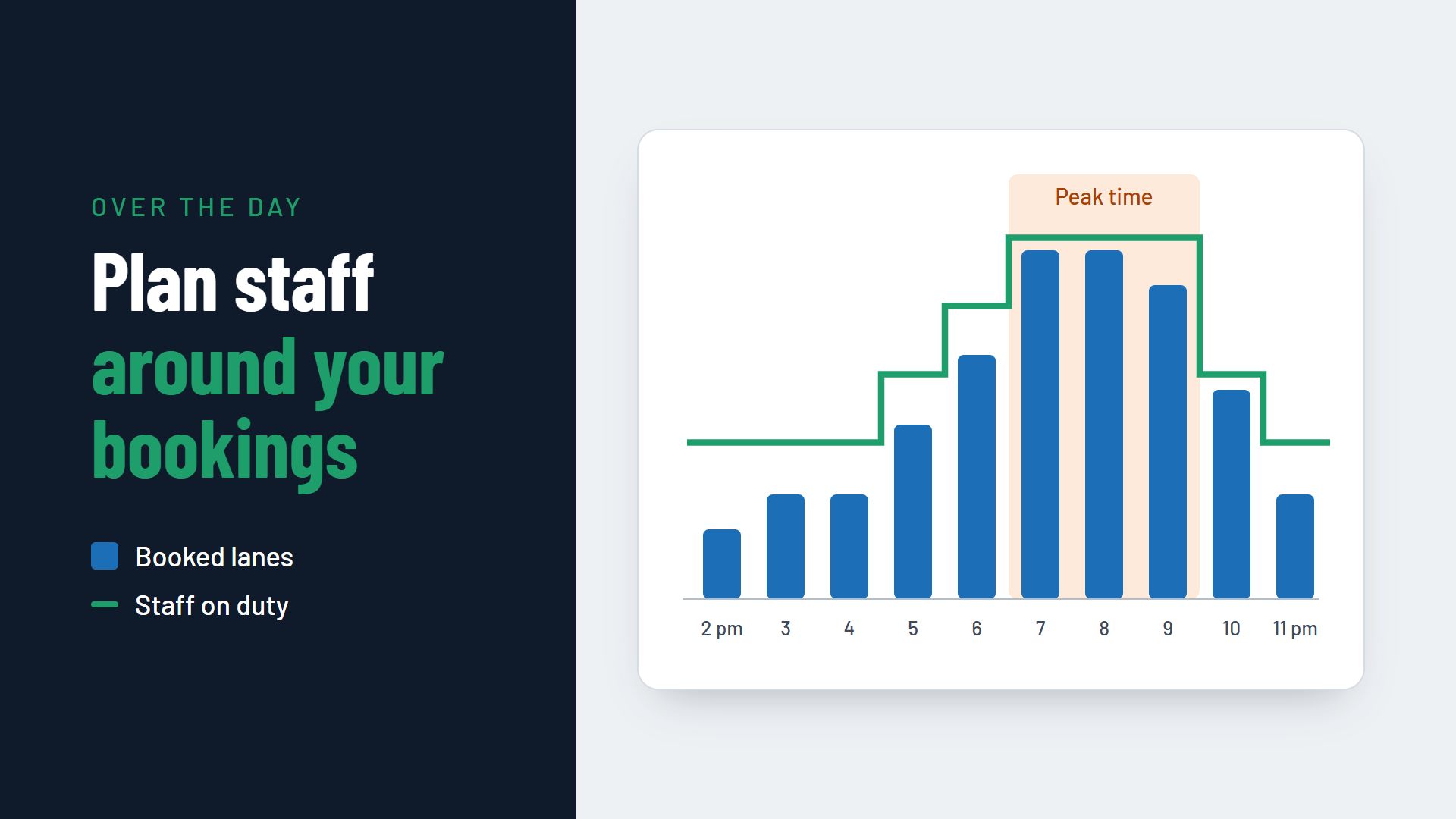
Lane occupancy over the day is the basis. It shows when the peak times begin and end, and therefore when you need more hands at the counter and on the lanes.
Number of guests and group size
Ten lanes with two guests each make different demands on your team than ten lanes with a company group of sixty people. Large groups need a welcome, a briefing and often more hire shoes at once.
Food, drink and packages
When guests choose food and drink as they book, your kitchen knows in advance what to expect. To find out how this works, read the article Selling food and drink with bowling bookings.
Cancellations and no-shows
How many bookings fall through on certain days affects how tightly you can plan. If you reduce no-shows, your rota becomes more reliable too.
How to work out staffing needs from bookings
1. Spot patterns from the past
Analyse the bookings of past months by weekday and time. Compare them with the previous year too: school holidays, public holidays, the weather and the Christmas party season often look similar year after year. This gives you a basic plan that fits a typical week.
2. Set a simple rule of thumb
Decide for your centre how many staff you need in each area at which level of occupancy, for example from how many booked lanes a second person joins the counter. These values depend on your centre, your food and drink service and your team. Write them down, so that everyone who draws up the rota plans by the same rules.
3. Factor in the current bookings
Before each week, check how many lanes, groups and packages are already booked. If the bookings differ clearly from the basic plan, adjust your shifts to the occupancy: more staff for the day with the big company event, fewer for the quiet evening.
4. Adjust at short notice
Even the best plan changes. Keep an eye on bookings made in the last few days and agree with your team how you will react at short notice, for example with on-call shifts or flexible finishing times. Check with your adviser which employment law requirements apply.
Predicting peak times and spreading them better
Booking data does not just help you react to peak times. It can also help you spread the load. If you see that bookings on Saturday cluster between 7 pm and 9 pm while the afternoon stays quiet, you can counter this with prices and offers. To find out how, read the article Dynamic and seasonal pricing for bowling lanes.
Group bookings can be planned too. If you offer fixed start times for parties and company events, large groups do not all arrive at once, and your team can welcome them one after another.
What a booking system should offer for this
To use your booking data for the rota, your system should:
- show occupancy per hour and lane clearly, for the coming days and looking back,
- record the number of guests, groups and packages in the same overview,
- summarise food and drink from the bookings for the kitchen,
- allow reports by weekday, time and period, so that you can compare previous years,
- be exportable, in case you draw up the rota in another program.
If you still manage your lanes in a spreadsheet or on paper, you usually do not have this data, or you have to gather it laboriously by hand.
Conclusion: plan by bookings, not by feel
Your bookings are the best forecast of how busy your bowling centre will be. If you use them for staff planning, you put your team where the guests are, keep staff costs under control and have to improvise at short notice less often.
To find out which features a booking system should have overall, read the page Booking system for bowling centres. One example of how occupancy and a booking overview come together in one system is Flexybox.