An escape room group booking works when your booking system can split a large group across several rooms in a single booking, with coordinated start times, one contact person and one amount. That requires rooms, game masters and the front desk to be planned together. A complicated email enquiry then becomes a booking your team can prepare without follow-up questions.
When a group is too large for one room
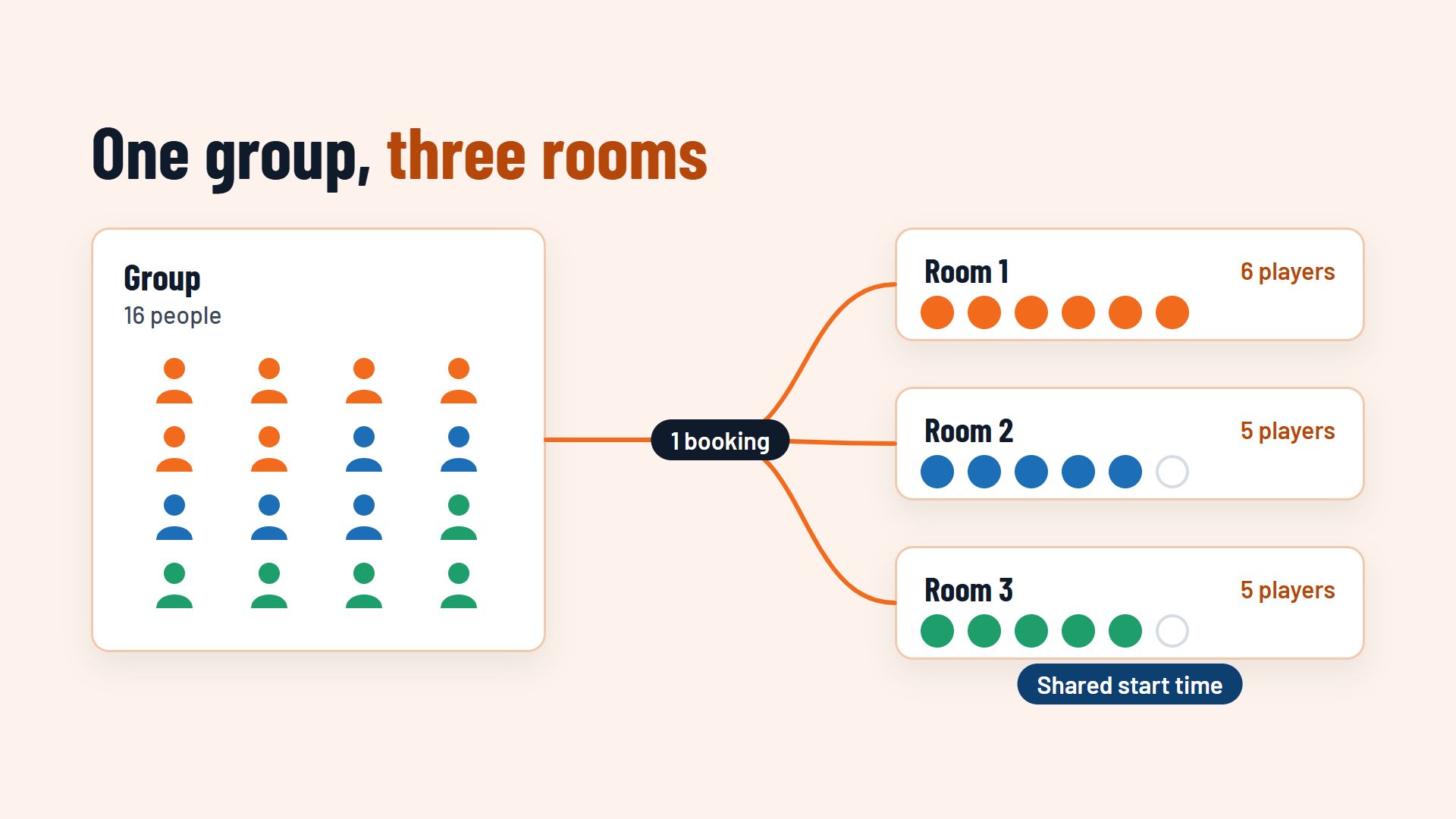
Every escape room has a maximum number of players. Company teams, school classes, clubs or stag and hen parties are often larger. An example: a group of 16 people wants to play, and each of your rooms takes at most six people. The group therefore needs three rooms, for example with six, five and five players.
Without a suitable system this turns into a chain of separate bookings. The organiser books room by room, hopes they are all free at the same time and pays several times. Your team cannot see straight away that the three bookings belong together.
Several rooms in one booking
For escape room group bookings, the guest should be able to enter the total number of people. The booking system then shows which rooms are free together at the requested time and offer enough places between them. The guest picks a combination, and all rooms end up in one booking with one booking number.
That has several advantages for you:
- Your team sees the group as a whole, even when it is spread over several rooms.
- Changes apply to the whole booking, for example when the start time moves.
- Payment and confirmation happen once, not per room.
Make sure only rooms that suit the group size are offered. A room with a minimum of four players makes no sense for a remainder of two people.
Same start time or staggered?
Many groups want a shared start, because they play against each other and want to compare results afterwards. For your venue, though, this means several groups have to be welcomed, briefed and supervised at the same time.
Staggered start times, for example a quarter of an hour apart, take pressure off your front desk and game masters. The group still meets up again at the end, just at slightly different times.
Planning game masters and the front desk
A group booking ties up more than rooms. If three rooms start at the same time, you will usually need more game masters at once as well. A booking system can treat game masters as a resource of their own and offer a combination of rooms only when enough supervision is free.
Think about space too: a large group needs somewhere to be welcomed, a cloakroom or lockers and, after the game, an area for photos and results. Plan the reset breaks of all rooms, so the next groups do not have to wait.
One contact person, one amount
Group bookings almost always have one person who organises and pays. They need:
- A total price that covers all rooms and extras.
- The option of a deposit, when the rest is paid on site or by invoice.
- An invoice, when a company books.
- A clear deadline until when the number of participants may still change.
If the group size changes, the booking should be adjustable without your team setting everything up again. If one person drops out, the room split usually stays the same. If several people join, the group may need another room.
Extras for groups
Larger groups often book more than the game: drinks, snacks, a room for the award ceremony or a group photo. Offer these extras directly in the booking, so you know in advance what to prepare. How this works for bowling bookings is described in the article Food and drink with bowling bookings. The principle carries over to escape rooms.
An enquiry instead of an instant booking for very large groups
Some groups are so large that they need more rooms than you offer together online, or they want a programme lasting several hours. An enquiry then makes more sense than an instant booking. What matters is that the rooms are already reserved provisionally in the system while the details are agreed, so they are not given to anyone else.
More ideas for groups, for example for stag and hen parties, can be found in the article Group bookings in a bowling centre.
Conclusion: handle escape room group bookings as one booking
Large groups are attractive for escape rooms, as long as they do not fall apart into many separate bookings. A booking system that links several rooms in one booking, plans game masters too and shows a total price makes group bookings simple for the organiser and predictable for your team. You will find more features on the page Booking system for escape rooms.
How several rooms, group prices and extras can come together in one booking is shown, for example, by Flexybox.